How To Paint Watercolor Cherry Blossom (In 15 Minutes!)
Why does starting a watercolor often feel like the hardest part?
I used to sit down, not really know where to begin, then try to paint everything at once… and end up with muddy, messy results.
And if no one’s ever shown you how to approach a painting before picking up the brush, you’ll get stuck right at the start every single time.
Most beginners think it’s a skill problem… but it’s not. It’s a planning problem.
It comes down to how you build the painting – breaking it into simple steps and layers instead of trying to do everything at once.
So in this video, I’ll show you exactly how to do that using this cherry blossom painting as an example.
We’ll break it down step by step, and by the end, you’ll have a clear way to start any watercolor – so you know exactly what to do first, and what to do next.
Don’t Paint Everything – Build it in Layers
This is the reference photo I created for this project. When confronted with a new subject, I think one of the biggest reasons beginners get stuck at the start is figuring out where to begin, and how to break down the painting process into manageable parts.
So here, I’ve done that thinking for you.
I’ve already broken this painting into a few simple steps you can follow.
Instead of trying to paint everything at once — which is where things usually go wrong — we’re going to build this painting step by step, so it feels much more manageable… and in the future you can use this same approach for any subject you paint.
It’s a bit like following a simple recipe – you don’t do everything at once, you take it one step at a time.
So let’s take a look at how this painting is broken down.
- The first thing is to transfer the sketch to a sheet of paper
- Then we’ll paint the flowers using a wet-on-wet approach
- Next we’ll paint the stems and leaves also using a wet-on-wet technique
- And finally we’ll add some details.
So the rule is “Don’t paint everything – build it in layers.” And for this painting, if you approach it this way, the whole thing only takes about 15 minutes.
Just a quick note – if you’d like to try this painting yourself, you can download the traceable outline and watch the full-length version of this lesson, which I share exclusively with my Patreon members. There’s also a full library of lessons there if you’re looking to build a regular painting habit.
Watercolor Cherry Blossom Tutorial
Step 1 – Keep the Sketch Light
Some beginners get stuck at the beginning… because they feel like the ‘drawing’ needs to be perfect.
But for watercolor, you only really need a basic pencil outline.
Transfer the sketch outline onto your watercolor paper. Tracing is absolutely fine and just helps you get to the painting stage faster. Keep the lines very light with as little detail as possible.
Also, if you’ve ever found yourself twisting your hand into awkward positions for some brush strokes… you might be making things harder than they need to be!
It helps to tape your paper down onto a board using low-tack masking tape.
That way you can simply turn the board as you paint, instead of adjusting your hand.
Remember: “Keep the sketch light – it’s just a guide, not the final result.”
(You can download the outline sketch here)

Step 2 – Start light, then build depth while the paint is still wet
Start painting the petals using a very diluted mixture of pink paint. This is where a lot of beginners use too much pigment.
But with watercolor, especially at the start, it’s mostly water. You might be surprised how little paint, and how much water you need to achieve a light-toned pink color.
Notice that the first petals I’m painting are in the background, so I painted these a very light pink to create a sense of depth in the finished painting.
Think of it like pushing some petals further back in space.
Continue painting all of the other petal shapes with a slightly richer mix of pink. Try to do this stage quickly so the shapes are all damp, then drop in a richer mix of pink into the center of the flowers and let it spread naturally. This is a wet-on-wet technique called ‘charging-in’.
As long as the surface is still damp you can add more pigment to the center of the flowers until you’re happy.
Once you’ve done this, stop and let it fully dry before moving on.
Letting the surface dry is important – it lets the paint fix to the paper before adding the next layer. If you’re impatient like me, letting paint dry is maybe the hardest part of watercolor! Now’s a good time to put the kettle on 🙂
Step 3 – Let the colors flow as one shape
Now you can start painting the stems and the leaves – we’re going to treat them as one connected shape.
I began with the flower buds using a neutral mixture of pink, then started painting the adjacent leaves in green without stopping between each shape. Think of it like painting one continuous shape that slowly changes color as you move instead of stopping and starting for each new shape.
Vary the color on your brush as you progress. I used very wet brush-strokes so I have time to change colors as I paint without the first brush marks drying. As a result the paints will merge into each other, creating a beautiful soft transition of color.
As you can see, I keep alternating between neutral pink and dull green to get a nice variety of color in the leaf shapes.
Painting a shape with an ever-changing wash of color like this is called a ‘variegated wash technique’.
The idea is not to paint separate elements – you’re building a single flowing shape with shifting color.
As you continue down the stem, you can introduce a bit of brown into your mix to add variation and depth.
And as you reach the end, simply add more water to your brush so the color naturally fades out.
And that’s it for the stems. Pretty simple but effective! The subtle changes in color makes it so much more interesting to look at than if you’d painted it all in one flat brown.

Step 4 – Add some details
Once everything is fully dry, we can move into the final stage and add a few final details…
I’ll paint these with a ‘wet-on-dry’ technique. In other words I’m painting directly onto a dry surface, as opposed to a damp shape. This is ideal for painting small shapes with sharp edges. This stage is the opposite of everything we did before where we wanted the paint to spread and blend… Now we want control.
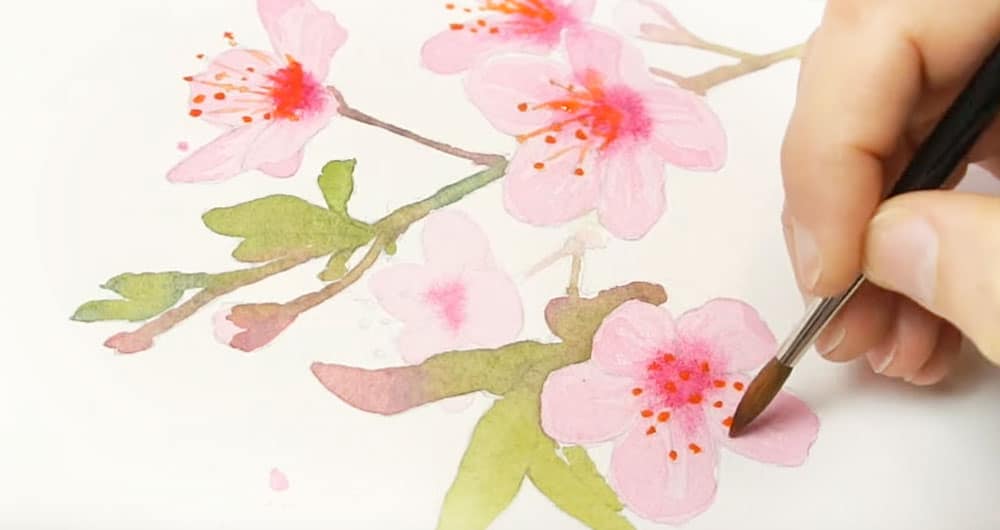
I switch to a smaller brush so I can work more precisely. Using a very diluted mixture of pink, I started adding some texture to the petals using lines radiating towards the center of the flowers.
Think of this as just “suggesting” detail not painting heavy lines. A lot of beginners overwork at this stage – it’s always tempting to add more, but too much detail can kill the freshness of the painting.
Next, using a mixture of orange paint I added some tiny dots of color and a few thin lines to represent the center of the cherry blossoms.
Keep in mind, not every flower gets the same amount of detail. Background blossoms should stay lighter and softer – for example, use a more diluted mixture of paint and add a few less brush marks. This kind of thing helps create depth. The eye naturally reads lighter and softer as further away – so those background blossoms will sit back in the painting without having to do anything complicated.
Finally, add a few light wet-on-dry strokes to the leaves and stems to bring everything together.
Just a few light brush strokes is all you need to create a bit more depth to these elements of the painting

Next time you tackle a watercolor painting try to remember this…
“Planning your paintings in this way allows you to start each new painting with more confidence… because you know ahead of time what you need to achieve in each step.”
If you found this helpful and want to go deeper, I have a full ad-free version of this lesson over on Patreon — along with a lot of other tutorials. Worth a look if you’re serious about improving…


I absolutely love your tutorials. The way you teach using step-by-step processes works well for me. Thank you for sharing your talenta in both skill and teaching.
You’re welcome Julie!
Beautiful! I love that you break it down for us. (then it seems so obvious lol). I’m going to try this. Do you have a reference photo? I only see images of your painting, which is fabulous, but I’d like to try it from a photo
Hi Suzi – Glad you like it 🙂
The reference photo and other guide material is available for my Patreon members. You can find out more here…
Anthony, I bought your course and cannot download the outline and other sketches? Can you help?
Hi Mary
Sure… The outline can be downloaded in the section called “Try This Painting For Yourself”.
Or click here
Thank you, perfect timing . Spring!
Enjoy Ginny 🙂